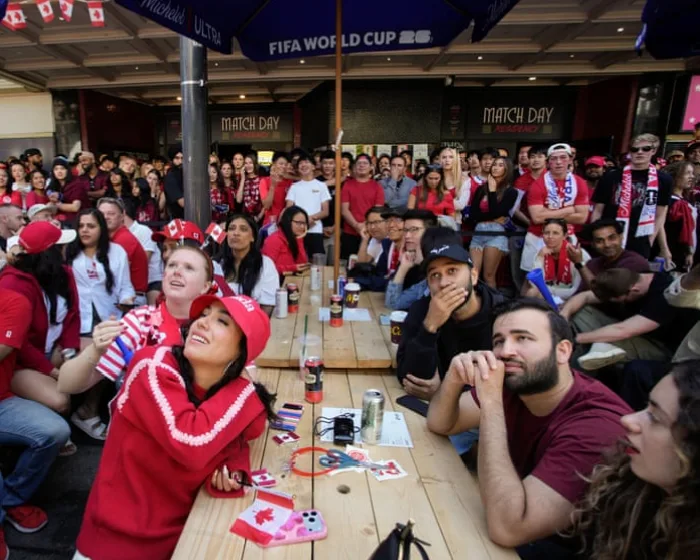
It was standing room only in Toronto’s oldest bar, The Wheatsheaf, on Saturday lunchtime. For some, the wake had already begun. Nestled in the corner was a group of sullen Irish GAA fans, who had just witnessed Cork’s demoralizing defeat to Galway in the All-Ireland Hurling semi-final. Resplendent in their red and white as they gazed despairingly into the middle distance, at least they had another team to root for.
- Fans in Toronto went into pandemonium for Portugal and Cristiano Ronaldo, dominating local attention around Toronto Stadium.
- Despite co-hosting, Canada inspired only muted celebration; moments like Cyle Larin, Qatar rout, and Stephen Eustaquio felt limited.
- Organizers called Canada a junior partner: temporary seating removed, future of professional clubs like CF Montreal and the domestic league uncertain.
- A cautious national temperament, highlighted by criticism of Jesse Marsch celebrations, leaves Canadian soccer waiting for real investment and answers.
It was an odd scenario. Canada is co-hosting this tournament but, due to the team’s second-place finish in the group stage, they were playing Morocco far to the south in Houston, Texas. But The Wheatsheaf was a sea of red and white as Canada fans gathered for the last-16 clash. Some guy even dusted off a vintage Manchester United 1999 jersey with ‘Beckham’ on the back. Anything for Canada. And that sense of collective patriotism soared when Wayne Gretzky – the once Great One now derided in his native land for cosying up to Donald Trump, amongst other curious missteps – popped up on TV screens and was booed mercilessly and enthusiastically by the crowd.
But that moment was a solitary act of communion for Canadian supporters. Other than the gasps and cheers that greeted Tani Oluwaseyi’s first-half effort that forced a hockey-esque stop from Morocco’s Montreal-born goalkeeper, Yassine Bounou, there was a sense of inevitability about this match. A resignation that this was the end of the road. Once Azzedine Ounahi opened the scoring five minutes into the second half, attention began to wane. As it became apparent Alphonso Davies would not enter the fray and sprinkle some much-needed magic, any remaining optimism was extinguished. As the full-time whistle went, there wasn’t much of a reaction. Some soft applause. No anger, no recrimination. But no dissection either. A place that had been heaving with fans quickly emptied. It was all a bit quiet.
For much of the week, the Canada game – a supposedly-seismic, historic World Cup knockout clash – was not the biggest soccer story in town. After all, one competing nation was literally stopping traffic.
The arrival of the Portuguese squad to the city ahead of their tantalizing last-32 match with Croatia at Toronto Stadium was greeted with pandemonium by a frenzied local diaspora. It began when hundreds of fans pulled over on the highway to catch a glimpse of the team bus on its way from the airport. Police were forced to shut down a portion of the road and lanes were blocked for an hour. But this was nothing compared to the volume of supporters that camped outside the side’s training sessions or turned up at downtown pop-up events. For three days, they gathered outside the team’s hotel, with Cristiano Ronaldo – like Eva Peron on the balcony of Casa Rosada – waving to the adoring masses below. Media outlets added to the feverish coverage, discussing the restaurants Ronaldo’s mother and sister visited and the dishes they ordered. When Portugal left town on Saturday, their fans again turned up in their droves to ensure a spectacular send-off. One lady couldn’t contain her excitement at grabbing the briefest half-glimpse of CR7.
“As they were leaving the bus, we caught the back of his head and the backpack,” she said. “It’s amazing, it’s a once-in-a-lifetime opportunity.”
It’s hard not to dwell on the parallels for Canadian soccer and how it has manifested with the country as co-hosts of this World Cup. Sure, there were the celebrations after Cyle Larin’s goal in the opening group-stage draw with Bosnia and Herzegovina. There was the weird and slightly uncomfortable joy of a 6-0 thumping of hapless Qatar. And the emotion of Stephen Eustaquio’s winner against South Africa. But none of those scenes could compete with the outpouring that Portugal experienced here or when Egypt took to the Vancouver streets after their 3-1 win over New Zealand and partied with supporters. With such hysteria surrounding other countries, why is it still so hard for Canada – even when they’re co-hosting a World Cup – to find some too?
It’s not exactly the Canadian way, usually because it’s a fine line between boisterous and obnoxious. When Jesse Marsch had the temerity to parade around the pitch in the aftermath of the Qatar annihilation – the country’s first-ever men’s World Cup victory – the extent of his celebrations was questioned. The usual style here is mild-mannered, considered and pragmatic to a fault. But, with a few things in flux, now’s not the time to be quiet.
The country has been a junior partner in this World Cup. Canada’s name is above the door but they haven’t got the juiciest cases, despite a serious level of investment. Still, they’ve done a fine job, made a name for themselves and provided some memorable moments. But, there remains a big question: what’s next? The temporary seating at Toronto Stadium will come down soon. In Vancouver, attention will revert to whether there’ll still be a professional men’s club in the city next year. Questions remain about the future of CF Montreal. Questions remain about the long-term viability of the domestic men’s pro league. Questions remain about where the investment and infrastructure will come from. But even with the swell of the summer and the magnitude of the World Cup, nobody seems to have many answers. Everyone is waiting and seeing. Pragmatic to a fault.
Canadian soccer history is punctuated with nearlys, almosts and a litany of missed opportunities. Let’s hope this World Cup isn’t another.