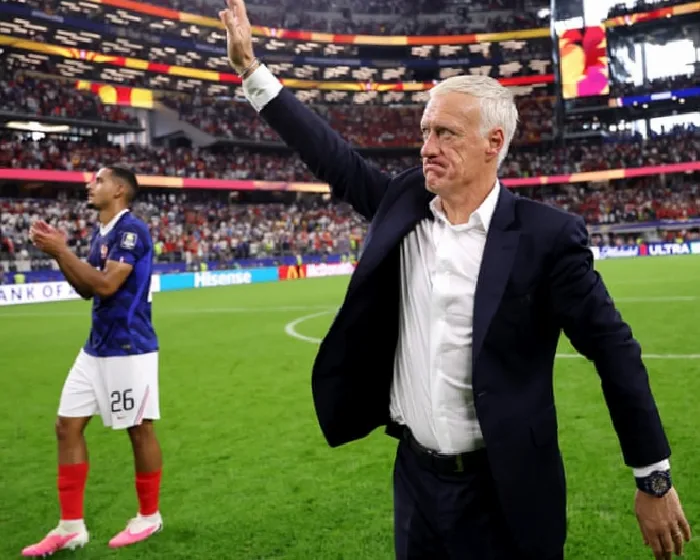
Maybe Didier Deschamps was right all along. He has been criticised over his 14 years in the France job for being too cautious, for prioritising control, for not unleashing his great fleet of attacking players. In this tournament, his last as national manager, Deschamps has relaxed – from a tactical point of view at least; he remains as grouchy as ever in his public utterances. France have played some glorious football over the past few weeks but when it came down to it, against the first truly elite side they faced, they were overrun. France could have done with being a little more Deschamps.
- France's tournament brilliance exposed eight years of lost potential, amplifying regret over what the side might have been.
- Didier Deschamps leaves with a World Cup, another final, and multiple semis, yet critics argue he stagnated France's progress.
- Spain's midfield supremacy decided matches; Lamine Yamal's foul on Lucas Digne epitomized France's vulnerabilities.
- Debate over switching from 4-2-3-1 to 4-3-3 mattered; withdrawing Adrien Rabiot proved insufficient against midfield control.
- Too many creative forwards left France exposed to transitions; including players like Manu Koné might have restored necessary balance.
The paradox at this tournament was always that the better France played, the more of a waste the eight years since they won the World Cup appeared. Admiration for their attacking excellence in the US has been tempered by a sense of regret for the potential beauty and joy Deschamps’ cussedness has denied the world over the past decade. This was the France they could have been all that time, playing with elan and panache, evoking legitimate comparison to the glorious France of the early-to-mid 80s.
It would be a stretch now to say they stand alongside the Hungary of 1954, the Netherlands of 1974 or the Brazil of 1982 as one of the greatest sides not to win the World Cup, but there was a point before the 1-0 win over Paraguay in the last 16 when that might have seemed an appropriate comparison.
Deschamps leaves the job having won a World Cup and reached another final and semi-final. He reached a Euros final and a semi-final. To get to the last four of five major tournaments over a 14-year stretch sounds like a remarkable achievement and in some ways it is. But Deschamps has been blessed with generation after generation of extraordinary players; one trophy with those players is perhaps only par. And there is an argument, voiced most vociferously by those grown weary of his football labeur, that Deschamps, for all his apparent success, held France back.
Why then did he change approach? He has been portrayed by some as the arch-pragmatist, committed neither to control nor to something more improvisational, but simply to what seemed best with the players at his disposal. It is indicative of just how out of character Deschamps’ selections have seemed how radically perceptions have shifted.
At the Euros two years ago, France were regarded as the dour, defensive unit, playing an unlovely version of the “tournament-ball” that had carried them to the World Cup in 2018, while Spain were the dashing update on juego de posición, capable of retaining possession in midfield but elevated by the pace and directness of their wide forwards. But in this tournament, as France sparkled, it has been Spain, their attacking options from wide diminished by injury, who have suffocated opponents.
If you include the Nations League, that is three tournaments in a row in which Spain have beaten France in the semi-final, process football triumphant.
There has been a theory that Deschamps has been forced into his reset by the evident brilliance of his creative options, and perhaps that is true, but France have had great attacking options – maybe not quite so many or so varied as they have now – for at least the past decade. Deschamps always seemed reluctant to let his attackers simply play, to release the handbrake; this game was the perfect demonstration of why.
There were only two doubts about this France: in midfield and at left-back. It was their misfortune that those matched up with Spain’s two greatest strengths. In the most obvious and direct sense, the penalty came from Lamine Yamal drawing a clumsy foul from Lucas Digne, but on a more fundamental level it was the result of Spain’s domination of midfield.
The question over the past few weeks has been whether, against stronger opponents, Deschamps would replace an attacking player with an additional midfielder, changing from 4-2-3-1 to 4-3-3. France’s creative play was so intoxicating that eventually came to seem impossible, but here it would surely have been a good idea. There were spells in the first half when Aurélien Tchouaméni and Adrien Rabiot were overrun. As it turned out, Deschamps’s solution was not to supplement the pair but to withdraw Rabiot. After a fine tournament, he had an awful first half and, with a booking, was an obvious red-card risk.
What if they had played Tchouaméni, Rabiot and Manu Koné from the start? What if they had played only two of Michael Olise, Ousmane Dembélé and Bradley Barcola alongside Kylian Mbappé? Given how little any of those three contributed, it could not have been any worse. With Spain dominating midfield, the vaunted attacking quartet simply did not get the ball often enough. Spain’s structure stifled them and, with too many players committed to creativity, France were left vulnerable to transitions.
In his ultimate defeat, Deschamps achieved his ultimate vindication. Talent is never to be trusted.