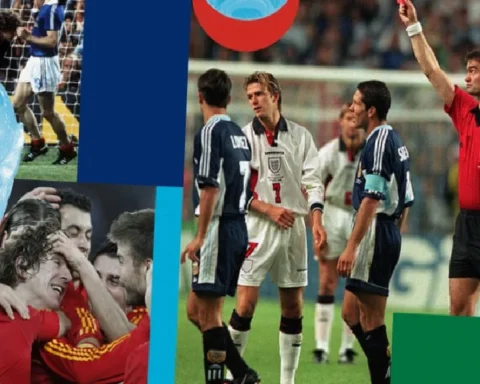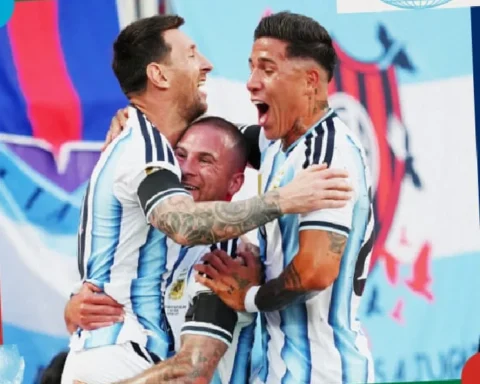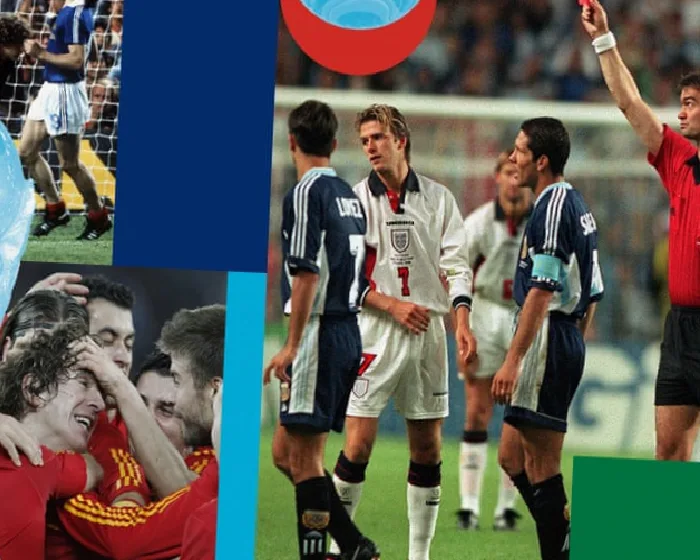
Amid the acrimony, the wars, the deep history going back to the British invasions of 1806 and 1807, the hand of God and the boot of Beckham, there is also an acknowledgment from those closest to the struggle that England and Argentina make perfect footballing sparring partners.
- Diego Simeone loved facing the English, praising their open, aggressive, passionate football as a proper contest.
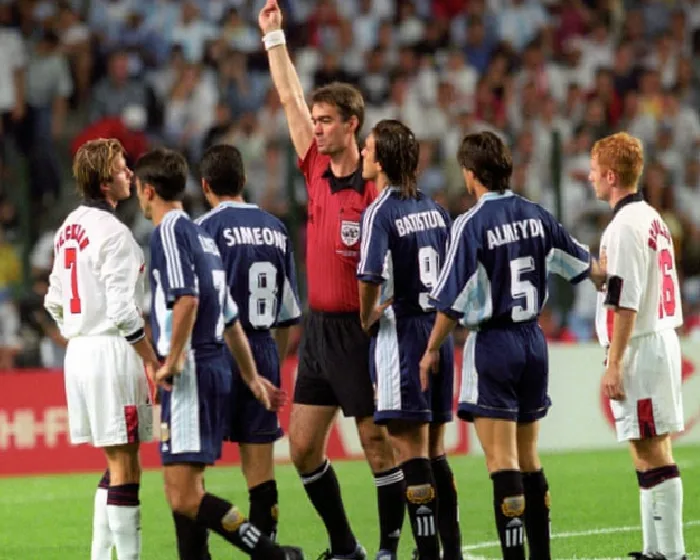
- Diego Simeone's feigned collapse led to David Beckham's 47th-minute red card, radically shifting the 1998 game's momentum.
- Michael Owen, aged 18, raced from halfway and finished brilliantly, earning praise from Glenn Hoddle.
- The 1998 tie ended 4-3 on penalties; Argentina erupted in celebration; Diego Simeone called knocking out England a huge joy.
- In 2002 England won 1-0 in Sapporo; David Beckham's penalty, won by Michael Owen from a foul by Mauricio Pochettino, who later admitted a dive.
Described as the only trans-continental derby, a rivalry hewn in politics and history as well as football folklore, most Argentinian footballers’ eyes light up when talk turns to England.
Take Diego Simeone, now the belligerent Atlético Madrid coach but once the arch nemesis of David Beckham, the man who feigned collapsing to the ground when Beckham’s foolish flick caught him at the 1998 World Cup, thereby altering the trajectory of that game through Beckham’s red card.
“I love playing against the English,” Simeone told me in 2002 when he and his then-wife, Carolina, hosted me at their sumptuous Rome villa for an interview prior to that year’s World Cup clash between the two nations. “English football is always more open, aggressive and passionate. Whether you win or lose against English teams, you always feel it’s been a proper contest. The first time I played against them was at Wembley in 1991 …” At this point, Simeone rolled up his trouser leg and pointed to a scar on his shin. “I’ve still got a souvenir from Stuart Pearce from that day. Great game.”
As for the famous clash in the last 16 in 1998, it was the first World Cup game since Diego Maradona’s hand of God in 1986 and again England were hoodwinked by Argentinian cunning, specifically Simeone’s. He, though, remembered it principally as one of the great World Cup contests.
“It is the best international match I’ve played in,” said Simeone. “They [England] were incredible that night. Alan Shearer and Paul Ince were extraordinary. At times it seemed Shearer was fighting us on his own. You have to remember they played for 70 minutes with 10 men.”
Simeone delivered the above line as though oblivious to the fact he was the main protagonist in that event. If not exactly repentant, he was a mite bashful about the world of pain he caused Beckham for his 47th-minute sending off. “Ten heroic Lions, one stupid boy” was the Mirror’s headline and an effigy of Beckham was hung from a noose outside a London pub.
“That’s way over the top,” said Simeone when I relayed the story. “It’s not that it frightens me but it’s a wakeup call for everyone, including journalists. You have to be careful.
“It was not just my fault. There’s a ref involved, too. I guess David had a torrid few months after that. The press were putting all the blame on him. I don’t think that was at all fair. He just made a mistake, an instinctive reaction.”
It should be said Simeone and Beckham were pictured together in Miami for Argentina’s game against Cape Verde. “Bumped into an old friend” wrote Beckham on Instagram.
While Argentina will always have Maradona’s second goal from 1986, a goal of considerably more consequence and frequently adjudged the best ever, England do at least have Michael Owen’s extraordinary run from the halfway line and finish to make it 2-1 in 1998.
Owen was only 18 at the time and in 2018 he met up with Glenn Hoddle, England manager that day, on the game’s 20th anniversary. “There was no fear in him whatsoever,” Hoddle told me. “When Michael turns, runs and beats the first couple of players, I remember thinking: ‘Bloody hell! He’s clean through!’ But [Argentine defender] Roberto Ayala was so deep, he was almost on the D of the penalty area and I hadn’t seen him. But as soon as Ayala squared up to him, it was clear he didn’t have a clue how much pace Michael had.”
Owen concurred. “Becks [Beckham] played the initial ball to me and one of their midfielders was only a couple of yards away from me. I just thought that, if I took a good touch, I could run past him and start an attack. It was only after the first touch, which I took in my stride, that I looked up and thought: ‘Oh my God – there’s a goal on here!’”
“As soon as I saw Ayala, who was isolated deeper, it was a case of making the best chance to shoot. You don’t want to go too close to him and get tackled. You don’t want to push it too flat and make the angle too hard. Then it was just about the finish.”
Simeone as much as admitted that Argentina hadn’t done their homework on Owen, who had only made his England debut that year. “He was a shock to us,” he said. “He was only 18 and we hadn’t seen him play. It was a pleasant surprise for the fans [but] not for us.”
As for the card shown by the Danish referee Kim Milton Nielsen, though it was hard to argue with in theory, the exaggeration of the impact made it hard to take. Hoddle recalled: “I thought: ‘Oh, here comes the yellow’, but suddenly the red came out. And I’m thinking: ‘What on earth is going on here?’ It was never in a million years a sending-off. Becks knows he did the wrong thing and that at that level they’ll make it into something else, which they did. But you need strong refereeing.”
In a separate interview later, Simeone conceded: “Sometimes you have to be a bit cunning and sometimes you play the fool. I happened to be the intelligent one. Beckham did nothing to me.”
The drama continued with Sol Campbell heading home what looked to be an 81st-minute winner only for it to be disallowed for a Shearer challenge. The England team were celebrating in the corner while Argentina played on, attacking David Seaman’s goal.
“It’s almost like I’m living it again. It’s so deep,” said Hoddle, recalling the moment 20 year later. “It scarred me. I’m looking down into the corner flag where Michael’s on Sol’s back. There’s about five players celebrating. Suddenly I saw Ray Clemence, the goalkeeping coach. He looks back towards the pitch and says: ‘What the fuck is going on?’ My eyes go back to the pitch and they’re attacking. It’s like a nightmare.”
Owen said: “How Argentina didn’t score from that was amazing. I think it was 11 against four!”
The denouement came in a 4-3 defeat on penalties. It’s fair to say the Argentinians embraced victory over the English. After the match, the respective team buses briefly drew up alongside each other outside the Saint-Étienne stadium. The Argentinian players leant into the euphoria of beating their old rival. “You could have been forgiven for mistaking them as fans,” said John Gorman, Hoddle’s assistant at the time. “They were jumping up and down like madmen.”
Simeone didn’t dispel the impression that this one meant more. “Knocking out England, with all the history that goes with that, was a huge joy,” he said.
There was revenge of sorts in 2002 and an indication that England were now more streetwise in the fixture. England triumphed 1-0 in Sapporo, David Beckham scoring the penalty won by Michael Owen from a foul committed by an Argentinian defender barely anyone in England had heard of back then, Mauricio Pochettino. When quizzed about his challenge on Owen, Pochettino always smiles and good-naturedly lectures his English audience on its sense of fair play. “For sure it was a dive,” Pochettino said.
“I could have stayed on my feet, the defender’s caught me and I did have a decent gash down my shin from it – but I could have stayed up,” conceded Owen.
Yet nothing quite encapsulated the duality that drives Argentinian football, the craft and the cunning, more than Maradona in 1986. Simeone, then a teenager, recalled watching the game with his dad.
“When Maradona scored the hand of God goal, my father shouted ‘handball’. I told my dad: ‘No, it’s a good goal.’ I just didn’t see it. Maradona was so quick. But the second goal proved he was the greatest player in the world.”
The deep origins of that second goal were a subject Simeone was keen to expound upon at length. “In Argentina, when we played in the street as a kid we didn’t call it football,” he said. “We call it jugar a la pelota [playing with the ball]. It’s prettier than football.It’s about beating players, dribbling, showing off. Football is something more professional, more serious and disciplined. In Argentina, dribbling past three players is the ultimate.”
And when Maradona scored the goal of the century against England? “That,” said Simeone, “was jugar a la pelota.