Fifa match officials’ novel use of the term “mistaken identity” reared its head again in sensational circumstances during Saturday’s World Cup quarter-final between Argentina and Switzerland, leaving the Swiss forward Breel Embolo in tears and the European side a man down for a total of 67 minutes against the defending champions.
- VAR reattributed the foul from Leandro Paredes to Breel Embolo, turning Embolo's earlier yellow into a red.
- Murat Yakin attacked the decision as a referee mistake, calling the rule unnecessary and "extremely hurtful".
- IFAB updated the mistaken identity rule before the tournament to permit transferring bookings when the other team committed the offense.
- After the call, Switzerland played extra time with ten men, conceded two late goals and were eliminated from the World Cup.
“It’s completely not understandable,” Switzerland’s head coach, Murat Yakin, said afterward. “I know that they will protect their referee but this rule destroyed the game today.”
The video assistant referee review and red card capped an extraordinary period that turned a previously-lifeless game on its head, with Switzerland netting an equalizer through Dan Ndoye in the 67th minute and growing into the game, only to be a man down five minutes later thanks to VAR.
The key moment came when the Argentina midfielder Leandro Paredes dove in to challenge Embolo as the forward darted upfield, seemingly catching his leg on the way. The Portuguese referee João Pinheiro initially issued Paredes a yellow card for the offense.
“First of all, there was definitely no reason to award that yellow card,” Yakin said. “I don’t understand it, it was a harmless situation.”
“It’s just a disaster,” the Switzerland midfielder Remo Freuler said. “I don’t know what the referee is doing here. I don’t understand why they call him for a situation like this because there are many fouls [like this] in the first half. Maybe he has to call them for yellow card too.”
Guillermo Pacheco Larios, the video assistant referee, recommended a review for mistaken identity after reviewing the footage, which showed Embolo leaving his feet and beginning his fall to the ground before Paredes made contact. The offense was then changed from recklessness by Paredes to simulation on Embolo, both of which are punished with a yellow card.
Embolo, though, had already received a yellow card in the first half, and thus he was ejected from the game. In this, Paredes could claim to have gotten a measure of revenge: Embolo’s first yellow card was for a clear foul on Paredes just before the end of the first half.
“It was decisive for the entire outcome of the match,” Yakin said.
Freuler added: “I don’t understand how can VAR change a game with this situation. Just let the referee do this thing, you know?”
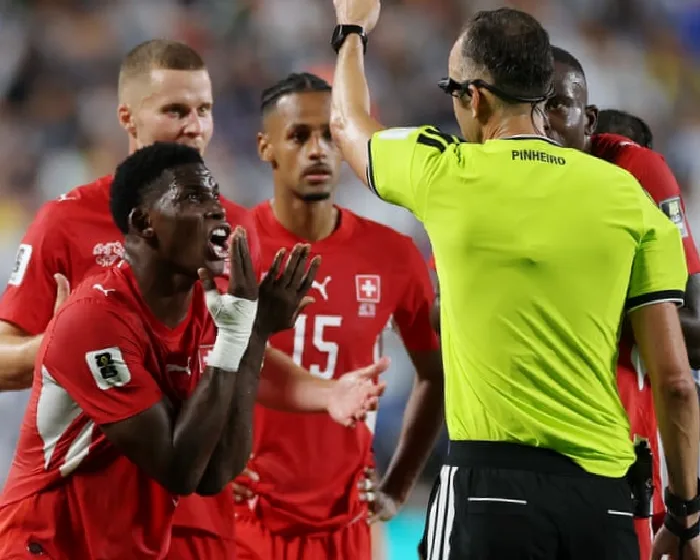
The Switzerland bench erupted when the decision was announced over the PA system at Kansas City Stadium, setting off wild celebrations among the majority pro-Argentina crowd. Embolo was among those who surrounded Pinheiro in animated disbelief. Embolo eventually broke down in tears, and had to be escorted by a small phalanx of teammates down the tunnel and back to the Switzerland dressing room.
“You can imagine how he’s doing,” Yakin said afterward when asked about Embolo. “He is shattered. He couldn’t help the team today. It hurts us and it hurts him. It was a referee mistake.”
Mistaken identity has been a valid reason for VAR review since the technology’s first implementation but until this World Cup it has almost exclusively been used for situations that obviously apply; for example, a referee issuing a card to a certain player in error when a teammate was the one who committed the foul.
This changed for the 2026 World Cup with the adoption of a new form of the rule by the International Football Association Board, the body that determines the laws of the game applied around the world. In its latest update issued before the World Cup, the board expanded the definition of “mistaken identity” to cover situations where a player was booked but the offense was committed by the other team.
Yakin admitted that he was not aware of the rule change before Saturday but continued to criticize the application of the rule.
“This is a rule that in my opinion has nothing to do with football,” he said. “The fact that they introduced such a rule is just unnecessary. It is just extremely hurtful.”
This was the second time the mistaken identity rule has been applied in this manner at the World Cup, with the first coming in the United States’ opening game against Paraguay. In that instance, the US defender Tim Ream was initially issued a yellow card for a foul against Paraguay’s Miguel Almirón but the VAR intervened and reviewed the action on the basis of mistaken identity. The referee went to the monitor and found that Almirón had actually dived on the play, and thus rescinded the yellow to Ream and issued it to Almirón.
In that case, several commenters raised concerns about the way the rule was applied but Fifa later confirmed it had been applied correctly. Saturday’s call will be more scrutinized due not only to the stage upon which it took place but also the effect: Argentina were given a one-man advantage just when they were seemingly beginning to lose control. Switzerland had to play all of extra time with only 10 men, and their worn-out defense eventually conceded twice in a span of nine minutes to exit the World Cup.