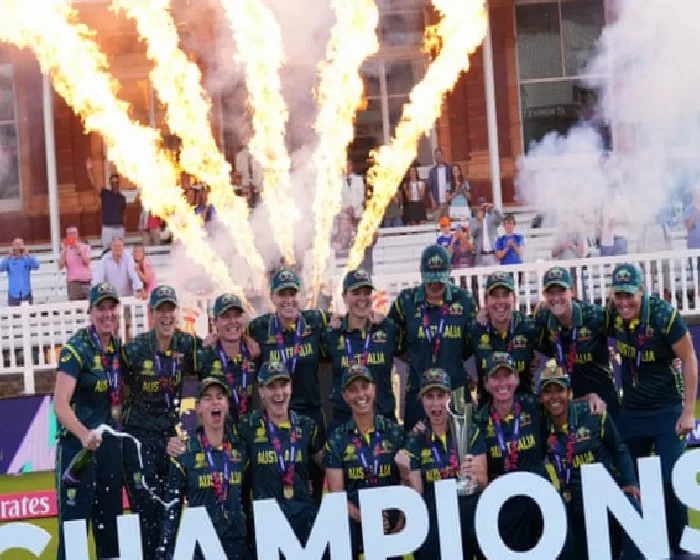
Players in the Australian women’s cricket team are not accustomed to being without at least one of the two global trophies. Many moons ago, there was a gap of 11 months after they bombed in the semi-finals of both tournaments in 2009, but they fixed that with the next edition of the T20 competition in 2010. Their longest wait was 16 months between the semi-final ambush by Harmanpreet Kaur in 2017 and the T20 win in Antigua the following year. The third and final gap ended on Sunday at Lord’s, eight whole months since Australia lost their one-day title in India last November.
- Australia's dominance persists; the brief hiatus did not alter their relentless winning culture.
- Youth stepped up: Georgia Voll, Phoebe Litchfield, Lucy Hamilton, and Kim Garth delivered fearless, match-winning performances.
- Veteran class: Beth Mooney, Ellyse Perry and Ash Gardner still win matches when it matters most.
- Sophie Molineux's calm, tactical leadership silenced doubts; teammates publicly backed her and celebrated an unbeaten World Cup run.
This is what passes for scarcity in Australian terms: a lost semi-final in the T20 tournament in 2024, and another in the one-day version in 2025. Beth Mooney, a player who before this victory had already won four World Cups and Commonwealth Games gold, said of her build-up that she “just woke up in the morning pretty grateful we made it this far.” Having presumably filled in her gratitude journal, she proceeded to make 64 from 49 balls to wrap up the voting on player of the match and player of the tournament.
It is absurd, on a purely statistical level, that a team that has now won seven T20 World Cups of the 10 ever played, and seven one-day World Cups out of 13, could either be concerned about or perceived to have any concerns about a lack of success. But such is the historical dominance of the Australian women that even this brief hiatus from silverware ownership stood out. There were questions posed before the tournament about whether recent changes in the team, including a clumsy captaincy transition and the introduction of younger players, might create any sort of vulnerability for others to exploit.
In two words: hell no. Australia’s youngsters have led the charge, with Georgia Voll adamantly aggressive opening the batting despite the times when that fails, Phoebe Litchfield just as fearless slotting in next, and Lucy Hamilton’s left-arm pace parsimonious when the fielding restrictions are in place. Kim Garth has lifted her status from a quirky story of an Irish import to being the most relentless seamer in the competition. Georgia Wareham embraced her shift in role from predominantly bowling to predominantly batting by topping the tournament strike rates at 182. Annabel Sutherland has left the emerging tag behind, Nicola Carey has come back from a hiatus, and both do any job asked of them. Around them all, the old firm of Mooney, Ellyse Perry, and Ash Gardner win matches when required.
Sophie Molineux as captain, meanwhile, has proved the least of anybody’s concerns. She has bowled tough overs and made good changes in the field. Her transition to leadership, and the team management’s explanation of such a left-field pick, remains imperfect, but nothing washes away procedural queries like success, and nothing says success like an unbeaten World Cup run. Her players made a specific point of namechecking her in interviews on the day to show their support.
Molineux is an interesting case. Her own broadcast interviews through the tournament have been honed to hide any glimpse of personality, but teammates apparently see more of it. In the lead-up to the final, a few hints broke through in a video from Cricket Australia, staged as a mock address to the nation from the Lord’s Long Room, urging Australians to put aside football for a day and concentrate on the cricket. In her eye was a glint of the sense of humour that apparently lies camouflaged.
In the aftermath of Australia’s win, Molineux resisted the invitation to jump on stage with the band Clean Bandit in the same way she did with Katy Perry at the MCG back in 2020, perhaps opting for a more sober bearing. But there was little doubt that she would be leading a more private singalong somewhere with her team later that night. Judging from the cheers coming from the Lord’s pavilion a couple of hours after the game, as the building’s lights increased their glow and the last shaded bars of the sunset lost theirs, the transition may not have taken that long at all. As for the team on the field, if there was indeed a transition for Australia to undergo, that didn’t take long either.