Perhaps it is not the when but instead the where. Golf’s majors in present form feel far too condensed, too brief. Jon Rahm, a two-time winner on the biggest stages, has more interest in the fact three out of four take place in the United States than their position on the calendar.
- Major season too condensed into an April to July run; hot streak winners benefit while general interest suffers; Rory McIlroy urges spreading it out.
- Complex governance blocks meaningful changes like ball specifications and scheduling; conflicting bodies such as the R&A and USGA hinder reform.
- Players accept limited control over calendar; Scottie Scheffler and others note season accelerates amid PGA Tour playoffs and Olympic influences.
“I think it would be good for golf,” said Rahm on the proposition of an “international” major. “If you could have more golf elsewhere, I think it would be fine. As a major, you need to have that commercial value as well. I understand it. I wouldn’t know the logistics of that. I don’t know who can decide what a new major becomes or is now a major.
“It would be interesting to see a major happen in other parts of the world, in other continents. Golf being a global game and as big as it is, it’s something that could be explored for sure.
“From what I’ve seen the last few years, having a major in Australia could be very successful. Having two in Europe would also be good fun. The same in Asia. I think there would be some great places to possibly have them.”
The epitome of a US sports league, the NFL, parachutes itself into foreign lands every year. There is fresh territory planned for this event, with a stop at Portmarnock in the Republic of Ireland due in the not-so distance future. The fiscal matters to which Rahm referred are the reason for that. Wonderful Open courses in the UK remain on the outside looking in.
By the time the final putt drops at Royal Birkdale on Sunday, around eight and a half months will have to pass before another major begins. This is terrific news for the Masters, which benefits from pent-up excitement among players and fans. Does it, though, serve the sport appropriately?
April’s spectacle at Augusta National precedes the US PGA Championship in May, June’s US Open and the battle for the Claret Jug in July. Fourteen weeks. Blink and you miss it. Minus a biennial Ryder Cup in September, this all feels rather feast/famine. As golf battles to command eyeballs, it has subtly introduced a truncated major run. The winners are players on a hot streak. There are losers aplenty, too.
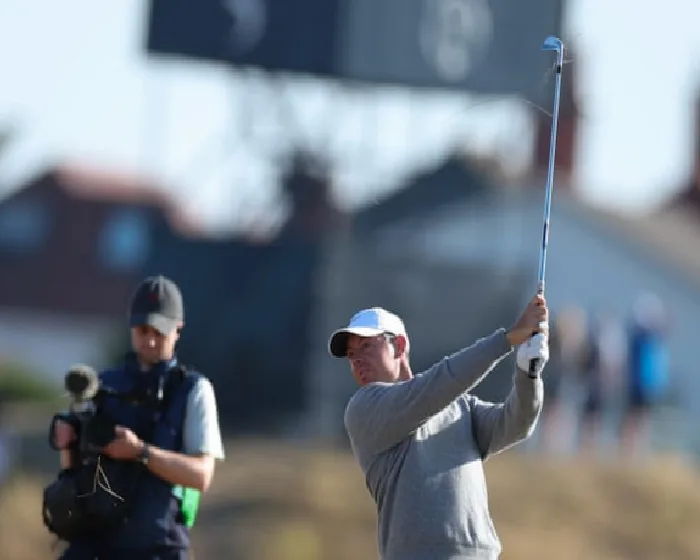
“I’d like to see the major season spread out a little bit longer,” said Rory McIlroy. “The Masters is always going to have the buildup but I think then PGA into US Open, US Open into here, it just seems like it’s very, very quick.
“From a player perspective, if you get on a bit of a run, it’s nice to be playing well and go from one straight into the next. But for the sport as a whole and for the general interest in the game, I can see the positives in that major season being stretched out a little bit longer.”
McIlroy thinks in big picture terms. He smiled when asked whether he may have offered this salient point of view to golf’s powers. “No, I’m done with that,” he said. “It’s a very complex jigsaw.
“Being a part of it [player committees] for a while, there’s a lot of different constituents in the game, a lot of different governing bodies and opinions. My opinion isn’t going to change anything. I would certainly voice it, but I don’t think it’s going to really change anything.”
Which is a pity. The convoluted nature of golf’s governance can be exemplified by one element: the ball. The R&A and USGA, supposed arbiters for the game, cannot adequately introduce specification changes – aimed at reducing driving distances – due to pushback from other parties. No wonder a lengthier major schedule seems impossible.
Albeit only a matter of weeks after the Open, the US PGA had strong meaning in August as “glory’s last shot”. The May staging of the US PGA can be difficult to separate from a typical stop on the PGA Tour. Golf’s reintroduction to the Olympics partly explains the shift.
So, too, does the PGA Tour’s end-of-season playoff system. The DP World Tour has a similar setup later in the year plus a marquee tournament at Wentworth in September. Players are typically and understandably reluctant to focus on a post-major drop off as it could diminish their achievements from July onwards.
Scottie Scheffler, the world No 1, like McIlroy has no interest in dictating tournament policy. He does agree with the Northern Irishman, though. “The season for us is getting quicker and quicker,” Scheffler said. “The season is getting more condensed and things are happening a lot faster. It goes by pretty quickly. I felt like we were at the US Open a couple of weeks ago.
“Maybe there could be more of a break, but that’s one of those things that’s so far out of my control, I couldn’t even begin to think about it. All you can do is just play the tournaments when they’re set up.”
This approach has served Scheffler well. Whether that of others is doing likewise for elite golf is another matter entirely.